
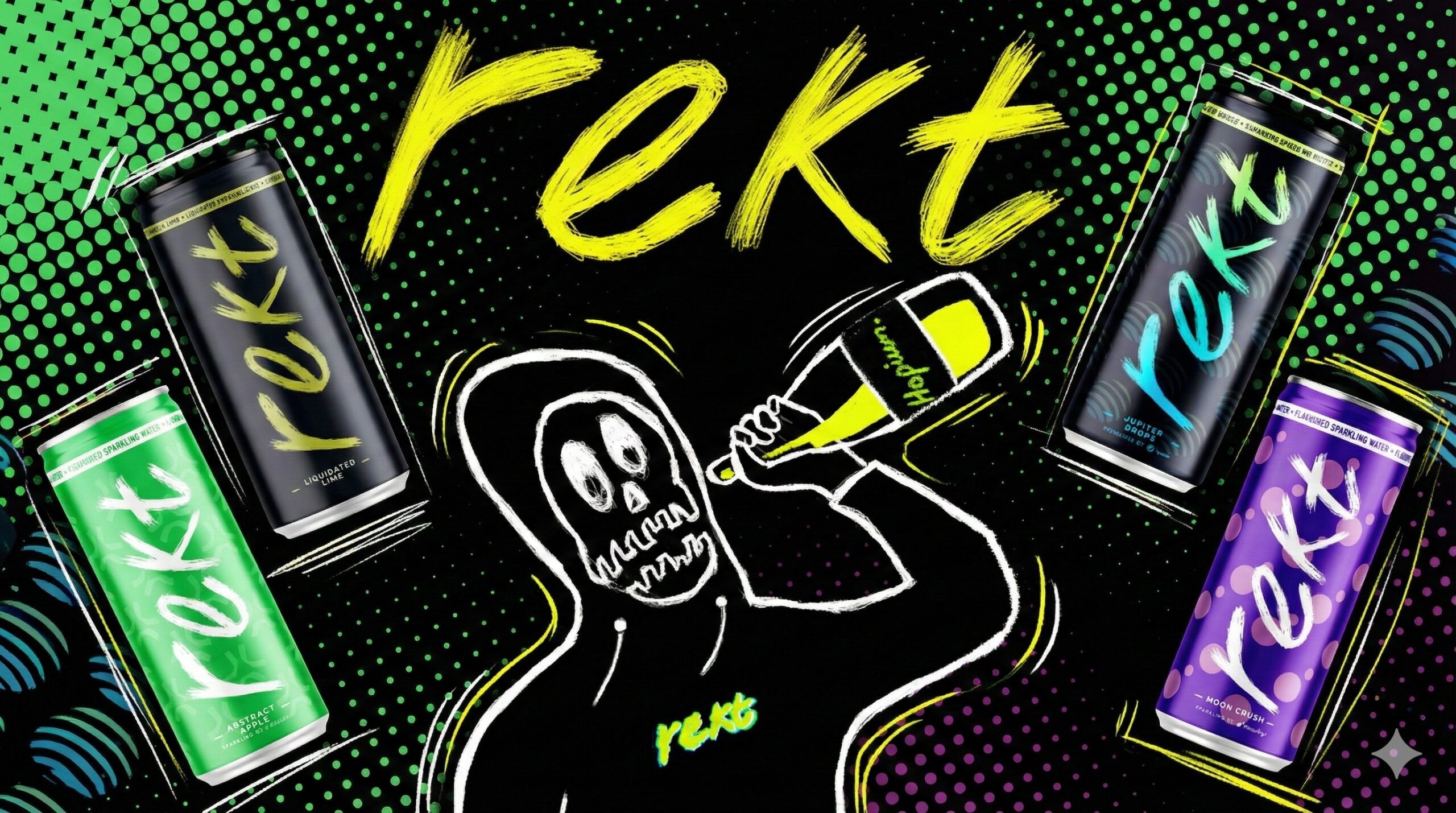
The cryptocurrency world has long been dominated by two extremes: complex technological projects (L1s, L2s) and purely speculative “memecoins.” However, as we approach 2026, a powerful new hybrid category is emerging: Brand Tokens.
Far from being simple Web 2.0 loyalty points, these assets—spearheaded by projects like REKT—are redefining the relationship between a brand, its community, and financial value.
What distinguishes a Brand Token from a standard memecoin? What can we expect for 2026? And most importantly, what are the dangers lurking for investors?
From Memecoin to Brand Token: The REKT Example
To understand the future, we must analyze the present. The REKT token perfectly illustrates the transition from “lol” to “business.”
Originally, “Get Rekt” was crypto slang for suffering a heavy loss. It was a culture, a shared sentiment. The REKT project capitalized on this cultural identity to create a tangible brand (notably with Rekt Drinks).
Unlike a classic memecoin which often lacks utility beyond speculation, a Brand Token like REKT aims to:
- Materialize Intellectual Property (IP): The token acts as a liquid extension of the brand.
- Create a Circular Economy: Using the token to purchase real products (drinks, merch).
- Federate a Tribe: The token holder is no longer just an investor; they become a brand ambassador.
2026 Outlook: The Tokenization of Loyalty
As we move toward 2026, analysts predict an explosion in this sector. Here are three major trends that will shape Brand Tokens:
1. The End of “Siloed” Loyalty Programs
By 2026, static loyalty points (which expire and are non-transferable) will be viewed as archaic. Brand Tokens will enable interoperability. Imagine earning tokens by buying a REKT drink and being able to swap them on an open market for USDC or tokens from another brand.
2. “Phygital” Integration (Physical + Digital)
The link between the physical product and the token will tighten.
- Verifiable Purchase: Scanning a can to “mine” a fraction of a token.
- Exclusive Access: Holding X tokens will grant access to IRL (In Real Life) events or private sales, creating natural buying pressure based on utility.
3. The “Cult-Economy”
Brands will no longer seek customers, but adherents. The Brand Tokens of 2026 will serve as vehicles for “lite governance.” Holders might vote on future flavors, merch designs, or partnerships, reinforcing emotional engagement.
Tokenomics Analysis: The Engine Under the Hood
For a Brand Token to survive until 2026, a cool logo isn’t enough. It requires a financial mechanism (Tokenomics) that captures the value created by the company. In REKT’s case, the model relies on a “Consumer-to-Asset” value loop.
Here is how this mechanics is designed to support the token price long-term:
1. The “Buyback & Burn” Mechanism
This is the Holy Grail of Brand Tokens. The economic model projects that a portion of the net profits generated by physical product sales (drinks, merchandise) will be used to buy back REKT tokens on the open market.
- The Effect: Constant buying pressure, uncorrelated with general crypto market sentiment (Bear or Bull market).
- The Result: These repurchased tokens are often “burned” (removed from circulation), reducing the total supply and mechanically increasing scarcity for remaining holders.
2. Utility as an Anti-Dump Shield
Unlike a pure governance token which is often sold immediately upon receipt, REKT aims to incentivize retention (HODL) via tangible benefits:
- Dynamic Discounts: Paying for drinks in $REKT offers a deeper discount than paying in fiat currency.
- Gamified Staking: Locking tokens to earn status within the community (access to private groups, exclusive drops).
The Key Equation: If the growth of drink sales (Real Demand) > token inflation, then the price has a mathematical fundamental support.
The Brand Token Arena: REKT vs. APE
To properly situate REKT, it is crucial to compare it to the giant of the IP (Intellectual Property) token sector: ApeCoin ($APE) from the Yuga Labs ecosystem (Bored Ape Yacht Club).
Here is a comparison of the two strategic approaches facing off in 2026:
| Feature | REKT (The Consumer Play) | APE (The Infrastructure Play) |
|---|---|---|
| Flagship Product | Consumer Packaged Goods (Drinks, Merch). | Metaverse (Otherside), Gaming, Digital IP. |
| Revenue Source | Physical Sales (Retail, Supermarkets). | Virtual Land Sales, NFT Royalties. |
| Accessibility | Mass Market: Everyone buys drinks. Very low barrier to entry. | Web3 Investors: Requires understanding of gaming/metaverse. Higher barrier. |
| Volatility | Medium/High: Depends on the success of a growing CPG brand. | High: Depends on technological adoption of the metaverse. |
| Philosophy | “Drink the Brand” | “Build on the Brand” |
The Verdict
While $APE bets on a digital and technological future (the infrastructure layer), REKT bets on integration into physical daily life (the consumption layer). In 2026, if metaverse adoption stagnates, “tangible” models like REKT could outperform because they rely on revenue in real dollars, not virtual speculation.
The Risks: What You Can’t Ignore
While the future looks promising, the terrain remains mined. Investing in Brand Tokens or building a strategy around them carries systemic risks.
Reputation Volatility
This is the major risk. For a stock market share, bad news might drop the price by 5-10%. For a Brand Token, a communication error or “bad buzz” can trigger a 90% drop in hours. The token’s value is directly correlated to the social “hype” of the brand.
Regulatory Ambiguity (MiCA and SEC)
By 2026, regulation will be even stricter.
Warning: If a Brand Token is deemed a “security” rather than a “utility token,” the issuing brand could face colossal fines, and the token could be delisted from exchanges.
Utility Failure
Many brands will launch tokens without a real economic plan. If the only reason to hold the token is the hope that it goes up, it remains a disguised Ponzi scheme. Without real demand for the underlying products (drinks, clothes, services), the token will eventually trend toward zero.
Conclusion: A Double-Edged Revolution
Brand Tokens like REKT are paving the way for an economy where the line between consumer and shareholder dissolves. For 2026, the winners won’t be those who shout the loudest on social media, but those who succeed in building a real product backed by a robust digital economy.
For investors, the golden rule remains: never confuse a strong community with a viable business model.